
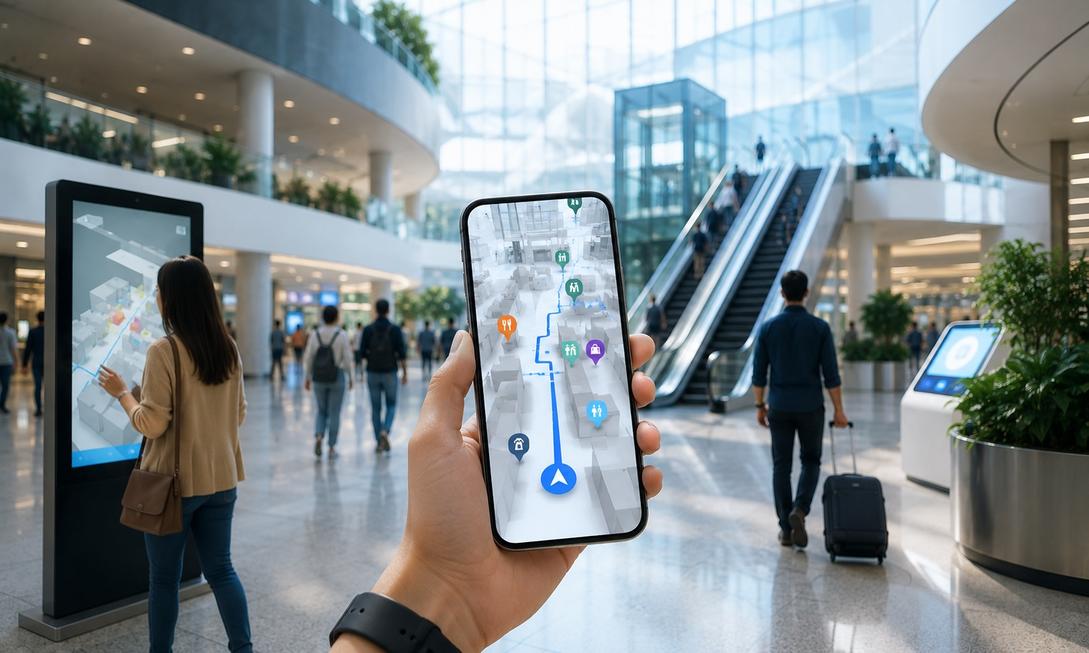
You’ve definitely had this experience: walking into a hospital to find the radiology department, rushing to a boarding gate at the airport, or looking for a booth at an exhibition center, only to stare blankly at static wall signs, take several wrong turns, and end up reluctantly asking people for directions. You could plan your route on your phone before leaving, but once indoors, GPS fails, and that discrepancy is truly frustrating.

From Static Signs to Dynamic Guidance: Why Traditional Signage Is No Longer Enough?
The traffic flow in modern venues changes too quickly. Hospitals adjust departments, airports change boarding gates, and exhibition center layouts differ with each event. Traditional static signs simply can’t keep up with these changes—this is where smart indoor navigation systems come into play. By combining touch screens, digital signage, mobile apps, and AI algorithms, visitors can instantly query destinations, get the best routes, and even receive updates when routes change temporarily, without wasting time getting lost.
Key Technology Highlights Behind It: It’s Not Just About Screens
- Digital Signage: Installed at entrances, elevators, or corridors, displaying maps, event information, and alerts in real time, with content that can be updated anytime.
- Interactive Kiosks: Visitors can search by department, store, booth, or meeting room, and input keywords to get clear directions.
- Mobile Navigation Extension: Plan your route before leaving, and your phone continues to provide guidance after arrival, integrating schedules, parking info, and real-time notifications.
- Indoor Positioning Technology: GPS is limited indoors, so these systems use Wi-Fi, Bluetooth beacons, sensors, and other technologies for precise multi-floor positioning.
- AI Smart Optimization: The system analyzes crowd hotspots, predicts bottlenecks, and guides crowd flow in exhibition halls or hospitals to reduce congestion.
More User-Friendly Design: Making Navigation Easy for Everyone
Good navigation isn’t just “fast,” it must also be “accessible.” Modern smart guidance systems provide accessible routes, elevator location prompts, large font modes, high-contrast screens, voice navigation, and multilingual support. Research shows that combining AR (augmented reality) with indoor navigation can help users reduce wayfinding time, lower error rates, and even decrease anxiety in unfamiliar spaces.
Who Should Implement It?
Hospitals, airports, campuses, shopping malls, exhibition halls, hotels… Any venue with complex layouts, high foot traffic, and a need to improve visitor experience can benefit. For management, backend data analysis reveals which areas are most frequently queried or where people tend to get lost, allowing optimization of signage and service configurations.
When the convenience of physical spaces finally catches up with the expectations of digital experiences, “not getting lost” is no longer just luck. A good smart guidance system makes every step in the space more relaxed. Upgrade your venue’s navigation experience now and let everyone easily find where they need to go!
