
Have you ever experienced that “blood pressure rising” moment? Your fingers have already pressed the buttons hard, but the character on screen reacts half a beat late as if it hasn’t woken up yet; or the modern controller you bought just six months ago already has the D-pad starting to “drift” like crazy, and even when playing online, you have to wait for that damn firmware update first?

In today’s world where modern controllers are becoming more like smartphones, packed with batteries, Bluetooth connections, and complex apps, we seem to have forgotten the power of “simplicity.” For fighting game players who demand millisecond precision, flashy features often just become a hindrance. Today, we’re not talking about nostalgia filters; we’re letting the data speak for itself, showing you 5 retro artifacts that have been tempered by time and outperformed modern wired controllers in latency tests. Speed is actually a matter of subtraction.
1. SNK Neo Geo AES Joystick: The Absolute Zero-Latency King
When it comes to “extreme speed,” Neo Geo claims second place with no one daring to claim first. This machine, once touted as “bringing the arcade cabinet home,” is equipped with true industrial-grade microswitches. Tests show its input latency is only about 0.77 milliseconds. This isn’t achieved through software optimization, but because it simply lacks those wireless signal conversions that slow things down.
- Usage Scenario: Hardcore fighting games (like Street Fighter, The King of Fighters).
- Advantages: True physical microswitches, withstand millions of presses without drifting, response speed more than twice as fast as modern controllers.
- Disadvantages: Bulky size, high price, requires adapters to connect to modern consoles.

2. Sega Genesis 6-Button (1993): The Speed Pioneer Hindered by Marketing
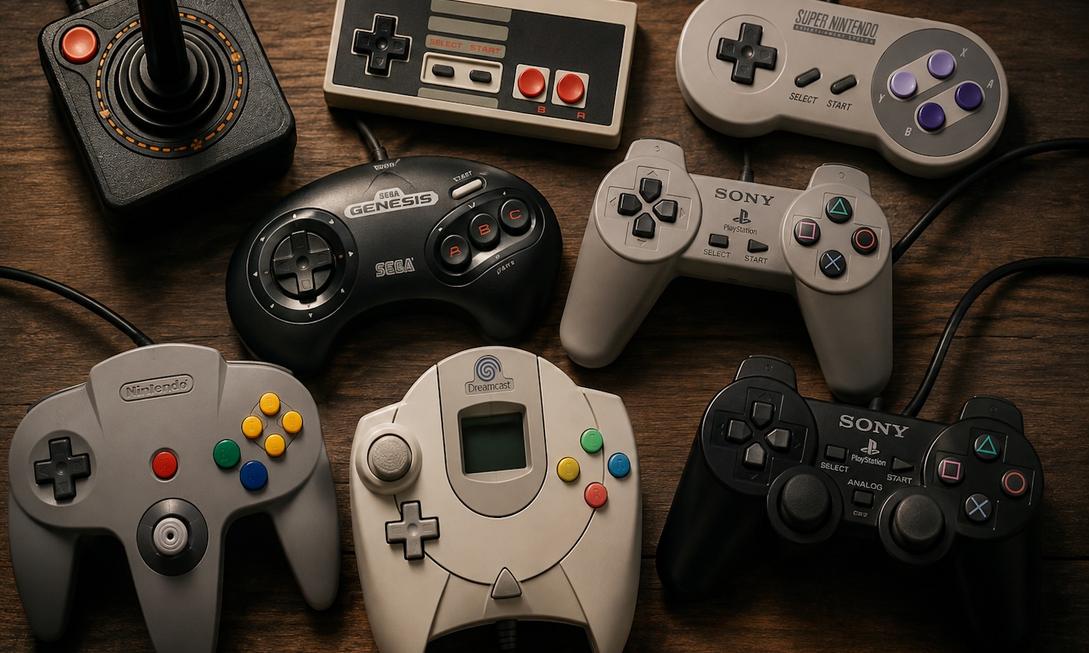
Although Sega spent its advertising budget on marketing terms like “Blast Processing,” the engineers quietly created a monster with response time below 0.91 milliseconds. It was the standard for the golden age of fighting games, and that physical “Mode” button, which existed specifically to solve old game compatibility, demonstrates the purity and elegance of the hardware back then.
- Core Benefits: 6-button layout perfectly suited for fighting game needs; the 1993 design possesses speed that surpasses 2020s products.
- Ideal For: Retro players and action game enthusiasts.
3. Super Nintendo (SNES) Controller: The Unparalleled D-Pad God
Although its data is about 1.48 milliseconds, closely following behind, in terms of feel and precision, the SNES D-pad is still considered the industry ceiling to this day. Modern controllers have made many modifications to prevent accidental touches, resulting in blurred inputs; the SNES only has “on” and “off,” this pure digital signal makes it synonymous with precise operation.
- Usage Scenario: Side-scrolling games and retro fighting games that require extremely high precision.
- Advantages: Unsurpassed D-pad feel to this day, plug-and-play, no pairing required at all.

4. Nintendo GameCube Controller (2001): Anti-Ergonomic Yet Most Understanding of Players
Although its D-pad is criticized for being not user-friendly, that huge A button and unique L/R analog trigger design still make many Super Smash Bros. players loyal. Its latency is about 2.38 milliseconds, not the fastest, but its grip design and button travel tuning allow fingers to maintain extremely high operational rhythm even during long play sessions.
- Design Highlights: Unique trigger design, allowing two inputs with a single finger.
- Note: Unique appearance and shorter cable, requires an adaptation period.
5. Sony DualShock 2 (2000): The Foundation of Modern Controllers
As the fifth place, DualShock 2’s performance is about 2.39 milliseconds. It made the list because it established the standard layout for modern controllers (dual analog sticks, shoulder buttons). Compared to modern DualSense that often require charging and automatic firmware updates, the DS2 is like a reliable tool with no unnecessary interference, only stable output.
- Core Advantages: Classic ergonomic grip, affordable price (great value on the second-hand market), extremely high durability.
- Disadvantages: Analog sticks will naturally wear over time, but that’s the mark of time, not a design flaw.

Conclusion: Reclaim the Purity of Control
Modern technology has given us vibration feedback, touchpads, and Bluetooth wireless, but it has also introduced unstable connections and inevitable drift. If you’re a fighting game player pursuing ultimate response, or simply tired of “having to fix the controller before playing,” these retro controllers (paired with quality adapters like Brook or 8BitDo) will definitely let you reclaim that pure “point and shoot” feeling from back in the day. Don’t let hardware latency limit your skills; switch to this old comrade and redefine your game speed!
