
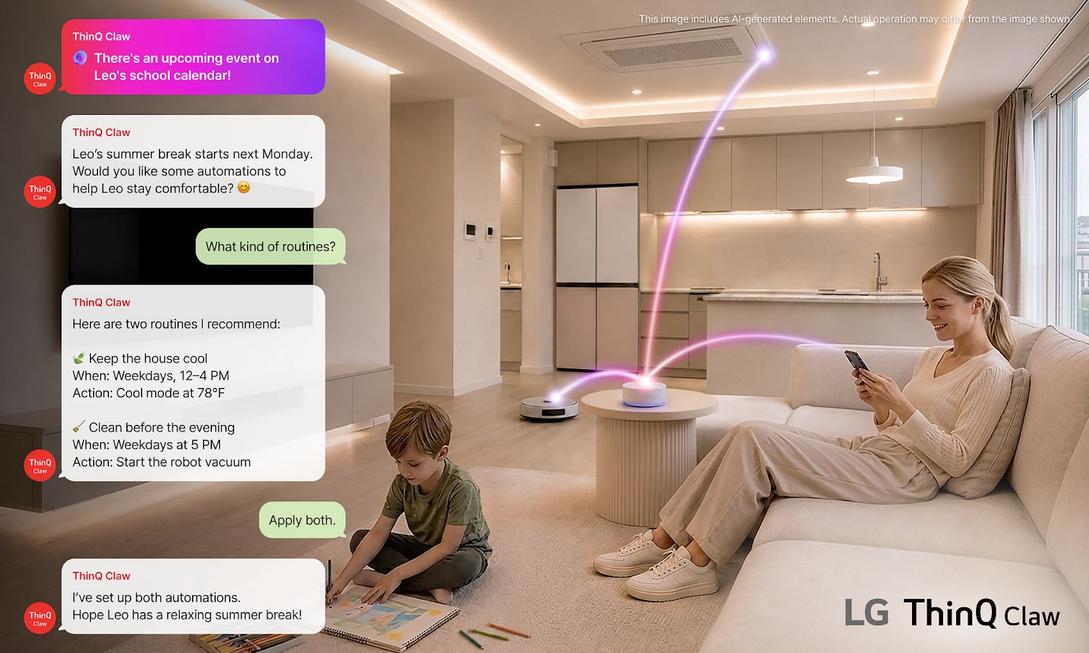
Every day after work, pushing open the door, the air conditioner isn’t on yet, the vacuum cleaner isn’t started, and the kitchen counter is still piled with morning coffee cups. As workaholic parents, who wouldn’t want the perfect temperature, clean floors, and even the oven preheated upon entering? But traditional smart homes always require manual scheduling or dealing with the frustration of switching between different apps. How perfect would it be if the home could “understand” your schedule and automatically prepare everything for you?

The AI Butler That Understands Your Schedule Has Indeed Arrived
LG’s latest AI Home Ecosystem, with the built-in ThinQ Claw Voice AI Assistant at its core. It’s not the kind of robot that requires you to memorize commands, but a smart butler that can directly understand natural language. Simply add “Friday night dinner with friends” to your phone calendar, and AI Home will automatically coordinate: adjust the air conditioner to a comfortable temperature in advance, open smart curtains to let in light, and even start the robot vacuum when you leave. For modern families with tight schedules, this is like directly deleting “invisible housework” from the to-do list.
Multi-Brand Devices Connected at Once, Smarter Energy Management
Many worry that switching to a new system will leave old appliances orphaned. LG has introduced Homey cross-brand control technology this time, allowing appliances from different brands to operate collaboratively on the same interface. More advanced is the system’s integration of solar panels, home batteries, and EV chargers, paired with a home energy management system that automatically stores energy during low electricity price periods and adjusts usage during peak times. Saving money while being eco-friendly is the vision smart homes should have.
Privacy and Control, the Essential Question in the AI Era
Of course, to make AI this thoughtful, the price is that it must “know” your life outline: your routines, appliance usage habits, and even shopping lists become fuel for the system’s computations. LG proposes the LG Shield Security Framework, emphasizing end-to-end encryption from device to data transmission, but consumers care most about two points:
- How is data stored and used? Are there clear retention periods and third-party sharing policies?
- Where is the boundary of AI autonomy? Preheating the oven or adjusting heating is fine, but for safety equipment like gas stoves, should the final manual confirmation button be retained?

Who Is Suitable to Embrace This AI Home System?
If you long to reduce daily decision fatigue and hope to switch directly to relaxation mode upon returning home; or if multi-device households have finally found a connection solution, LG AI Home indeed paints an enviable blueprint. But the prerequisite is that the brand must more transparently disclose the security details and operational boundaries of the ecosystem.
The endpoint of smart homes is not to let machines replace life, but to let technology quietly retreat behind the scenes, returning time to the truly important people. When the home learns to think one step ahead for you, are you ready to hand over that key to “understanding you”?
