
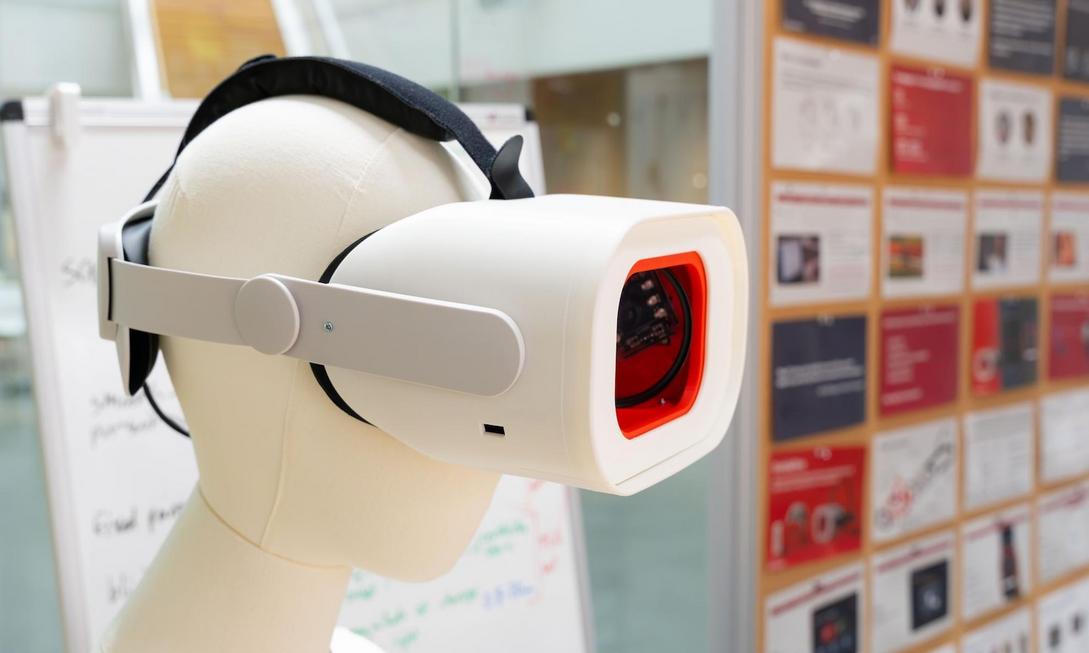
At the weekend soccer field, a young player sways to his feet after a fierce header collision. Though he forces a smile and says “I’m fine,” the coach’s underlying concern is impossible to hide. In the past, we relied on athletes’ “subjective descriptions” to determine if the brain was injured, which is akin to gambling at the edge of safety. When traditional Q&A fails to provide precise answers, Rumble Rims, developed by a Harvard University team and recently awarded the 2026 James Dyson Award, offers the most reassuring solution through technology.
Say Goodbye to “Gut Feeling”! Objective Data from Infrared Eye-Tracking

Unlike the past, where one could only repeatedly ask “Do you feel dizzy?” or observe for obvious external injuries, Rumble Rims hands the judgment standard over to science. Before arriving at the current head-worn design, the development team went through countless iterations from helmets and mouthguards to chin supports, ultimately finding this lightweight and precise solution.
The core of this award-winning device lies in the perfect combination of a side-mounted infrared camera and a 45-degree dichroic mirror. Sounds full of hardcore tech? In fact, its operation is extremely intuitive. Users simply wear the device, and in just 2-3 minutes of assessment, the system can precisely capture how the eyes move, focus, and track. Brain nerve damage often first manifests in subtle abnormalities in eye movement, and Rumble Rims converts “I feel okay” into “Data shows attention is needed” through these hard-to-detect data points, providing coaches and trainers with solid, unbiased decision-making basis.
See Results in 2 Minutes: Real-Time Screening Dashboard on Mobile

Imagine at a noisy sideline, without needing to transport bulky medical equipment or wait for an ambulance to arrive for initial assessment. Rumble Rims was designed with “sideline accessibility” in mind. After testing, all data is instantly synced to the connected mobile device. Through a dedicated mobile display interface, Rumble Rims offers coaches three core advantages:
- Real-Time Data Guidance: Objectively presents nervous system status, completely eliminating blind spots from subjective guesswork.
- Reduced Decision Risk: Quickly decide whether to pause the game or immediately seek professional medical assistance.
- Simple and Intuitive Operation: Easy to use without deep medical background, perfectly integrating into various sports scenarios.
It is not meant to replace professional physicians’ diagnoses but to provide a powerful “first line of defense.” In fast-paced sports events where every second counts, each accurate judgment reduces the risk of secondary injuries.
From Sideline Emergency to Long-Term Recovery: Full-Cycle Health Protection

Concussion recovery is by no means instantaneous. Rumble Rims’ greatest strength is that it is not just a one-time detection tool. Its built-in “Recovery Dashboard” feature allows athletes to perform multiple repeat tests during recovery, thereby building a continuous personal data record.
Parents and clinicians can clearly track brain function recovery progress through these long-term data trajectories. This is undoubtedly a powerful tool for establishing scientific health management in grassroots sports and school sports programs with limited resources. The team is currently using the award prize money to develop higher-fidelity prototypes, aiming to make this technology standard safety equipment for schools and youth sports programs.
Conclusion
With its lightweight appearance and precise infrared technology, Rumble Rims successfully fills the gap in real-time sideline concussion screening. Whether you are a grassroots coach, school trainer, or a parent constantly concerned about your child’s sports safety, this low-cost objective detection tool is definitely a must-have upgrade on your sports protection list. Don’t let brain health rely on guesswork—use scientific data to add the most reliable insurance to every sweaty moment.
